Intent
Leigh Academy Bexley delivers the International Baccalaureate Middle Years Programme in key stage 3, offering the full national curriculum through the MYP framework. The MYP, like other IB programmes, seeks to develop inquiring, knowledgeable and caring young people who help to create a better and more peaceful world through intercultural understanding and respect.
Learning is organised into eight subject groups all of which must be delivered through a minimum of 50 hours teaching time per academic year.
All learning is framed within Global Contexts which are cross curricular forging links to real world issues, making learning more meaningful and relevant.
The MYP also seeks to develop students as lifelong learners through the explicit teaching of Approaches to Learning. ATL are skills designed to enable students in the IB Middle Years Programme to “learn how to learn.” ATL skills are divided into five major categories:
- Thinking skills, including areas such as critical thinking, creative thinking and ethical thinking.
- Research skills, including skills such as comparing, contrasting, validating and prioritising information as well as digital and media literacy.
- Communication skills, including skills such as written and oral communication, effective listening, and formulating arguments.
- Social skills, including areas such as forming and maintaining positive relationships, listening skills, and conflict resolution.
- Self-management skills, including both organisational skills, such as managing time and tasks, and affective skills, such as managing state of mind and motivation.
We create clear progression pathways from key stage 3 to key stage 4 and beyond. Students are able to choose from a wide variety of academic and vocational subjects in languages, the arts, technology and business. It is our aim to continue the development of key aspects of the MYP in key stage 4.
Our spiral curriculum allows students to embark on a two year period of study building on their knowledge and skills in a broad range of subjects that prepare them for their future education and careers.
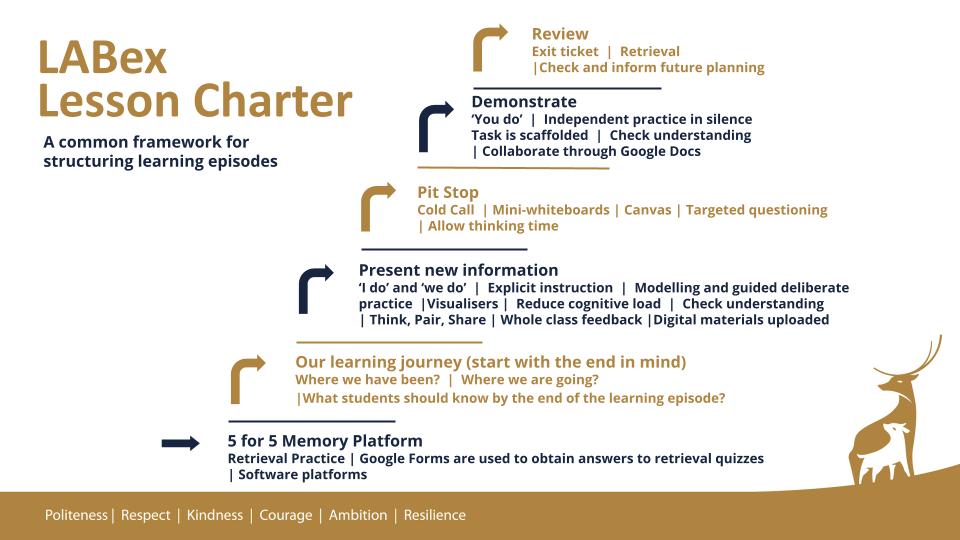
Our pedagogical approaches are underpinned by evidence based research. The LABex Lesson Charter is based upon Rosenshine’s Principles of Instruction and our Teaching and Learning Principles so that all lessons have a clear structure that builds upon prior learning, introduces new knowledge and skills with sufficient time to address misconceptions and consolidate learning through deliberate practice. Our lesson framework outlines six clear stages that help deliver these principles consistently while allowing teachers to apply their professional expertise and creativity.
Our spiral curriculum is collaboratively planned and carefully sequenced to develop breadth and depth of knowledge and skills over time. Lessons are planned and adapted to meet the needs of all learners. Disciplinary literacy is a core element of our curriculum.
Learners are supported and empowered through our digital strategy. All lesson resources, homework, digital tools, digital library and state of the art learning platforms are accessible to all students through our Chromebook scheme. Students learn how to keep themselves safe online and have enhanced protection via Smoothwall.
Our Assessment Policy outlines our approach to ensuring that our students receive regular and timely feedback and support which helps them to learn and progress. We use formative and summative assessments to address misconceptions, plug knowledge gaps and identify where further intervention and support may be needed.
In key stage 3 we use the MYP Assessment Criteria to assess student progress over time.
In key stages 4 and 5, the assessment objectives outlined in the subject specifications are the main vehicles used to determine academic achievement. We collect data at appropriate intervals and use Lenz (Trust data analysis tool) to review academic attainment and progress and benchmark against national standards.
We have a comprehensive approach to developing reading and literacy so that our curriculum is accessible to all of our learners. We measure the impact of the various strategies and make adaptations when needed.
Monitoring of the wider and co-curriculum also takes place to uphold our vision of an inclusive and holistic education. We gauge the opinions of stakeholders through parental and student surveys and Trust Executives, Curriculum Advisors and Governors undertake regular quality assurance visits to the academy.
We support all of our students to secure meaningful destinations taking great care to ensure that none become NEET (Not in education, employment or training).
 Skip to content