Skip to content




Dear Leigh Academy Bexley Community,
We are almost at the end of module 5 already, just one more week until the early summer break. As you will already be aware we welcomed Ofsted to Leigh Academy Bexley this week for the first inspection since joining Leigh Academies Trust in June 2023. Thank you to all those parents and carers that supported us by providing their views on Ofsted ParentView. This information, along with the views of staff and pupils, forms an important part of the inspection process. The outcome of the inspection must remain confidential until the report is published, it will be shared with parents and carers before the wider public can access the report.
Despite the week’s unpredictable weather, the academy remains a calm, purposeful, thriving learning environment. We are focused on ensuring the comfort of our pupils, in particular the exam cohorts as they sit their external examinations.
The poster below is a reminder to the whole academy community that we are a nut-free academy. Please do not add any nut-based snacks or products to your children’s lunch boxes. This includes hazelnut spreads and peanut butter chocolates and snacks. Our catering provider, Cucina, works extremely hard to ensure that no allergens are introduced into the academy environment and we ask the whole academy community to cooperate with this important aspect of academy life.
Please enjoy the articles below and as always, if we can support you in any way, please contact us via info@bexley.latrust.org.uk, where we will make every endeavour to respond within 24 hours.
Best wishes,
Mr John Dixon | Principal, Leigh Academy Bexley

Celebrating Success in Communication & Literacy

This term, we are shining a light on the incredible strides our Key Stage 3 students have made in their communication and reading skills. Through our Secondary Speech Link and ReadingWise programmes, we are ensuring every student has the tools to express themselves with confidence.
Secondary Speech Link: Empowering Every Voice

Secondary Speech Link is a specialist programme designed to support the complex communication skills students need as they transition through secondary school. It helps students navigate social interactions, understand complex instructions, and develop classroom confidence.
- Expert Support in Year 7: We have invested heavily in specialist care, with 44% of the year group receiving expert sessions with our Assistant Educational Psychologist (EP) and 78% of students benefiting from LSA-led support.
- Rapid Progress in Year 8: Our interventions are working! 42% of students in the programme have already accelerated their scores into the “Average” range.
- High-Impact Intervention: 91% of Year 8 students identified for support have worked directly with our Assistant EP to bridge communication gaps.
ReadingWise: Accelerated Literacy Growth

The ReadingWise Decoding Unit is a high-impact digital intervention that targets the core mechanics of reading. It is designed to help students who need to boost their reading age quickly and effectively.
- In just 8 months, students across Years 7–9 have made an average of 2 months of reading progress.
- Our students are currently progressing at nearly double the expected rate, ensuring they can access the full breadth of our secondary curriculum with ease.
These results are a testament to our students’ hard work and the dedication of our specialist support staff. By focusing on these core skills now, we are building the foundation for long-term academic success and personal confidence.
Well done to all our Year 7, 8, and 9 students!
Chess Club in the Library
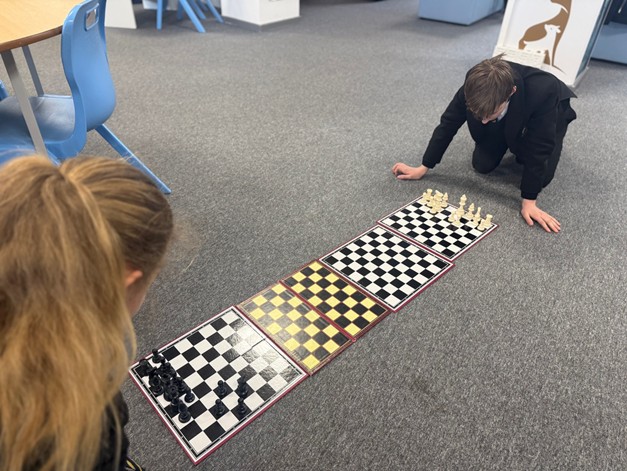
This week, during our chess club in the library after school, some of our students were playing an intriguing game on the “world’s” longest chessboard, learning how to create master moves to generate infinite opportunities. LABex students have the most fun.
Marshmallow Challenge
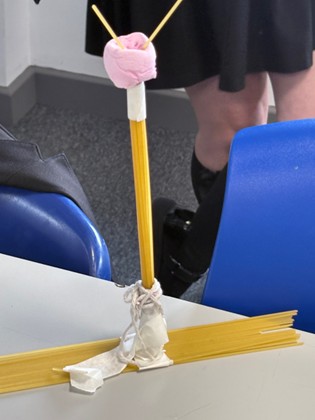
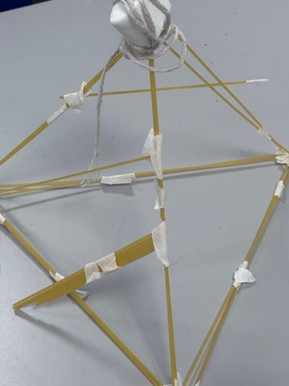
Year 7 students recently took part in the Marshmallow Challenge as part of their PSHE Enterprising Skills unit. Working in teams, students were tasked with building the tallest free-standing tower possible using spaghetti, tape, string and a marshmallow.
The activity encouraged students to develop important skills such as teamwork, communication, resilience and problem-solving. Students quickly discovered that successful teams were not always the ones with the “perfect” plan, but those who tested ideas, adapted when things went wrong, and learned from mistakes.
The challenge sparked excellent discussion about how people improve through experimentation and collaboration, with students reflecting thoughtfully on what helped their teams succeed. It was fantastic to see such creativity, determination and teamwork on display across the year group.

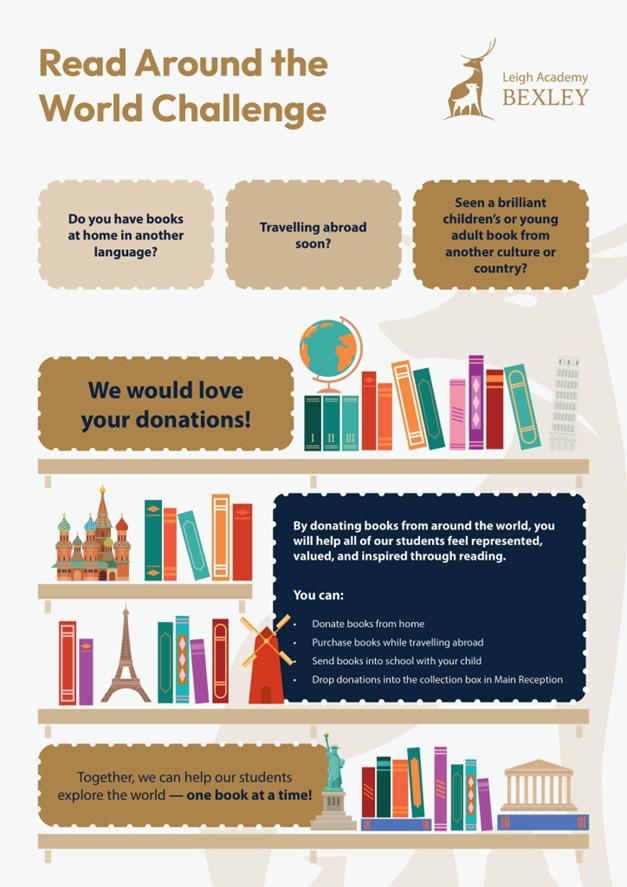
If you have any questions, please contact our Library Manager, Mrs Allen via info@bexley.latrust.org.uk
Understanding Eating Disorders and ARFID
Navigating a child’s relationship with food can sometimes be challenging, and as a parent, it is natural to worry when your child struggles with eating. While many people associate eating disorders strictly with body image concerns, the reality is much broader. One increasingly recognised condition is Avoidant/Restrictive Food Intake Disorder, or ARFID.
We want to share some important information to help you understand ARFID, recognise the signs, and learn how you can support your child, both at home and with the help of our academy.
What is ARFID?
ARFID is an eating difficulty where a young person eats too little, avoids many foods, or becomes highly anxious around eating.
Crucially, ARFID is not driven by body image concerns or a desire to lose weight. Instead, it is about safety, sensory overwhelm, and a nervous system that is trying to cope.
Why it happens:
ARFID can be driven by sensory sensitivities (where certain textures, smells, or colours feel unbearable), a fear of choking or vomiting, a painful past experience, or an anxiety response often linked to neurodivergence. For these children, eating feels risky, unpredictable, or physically uncomfortable.
How it shows up:
This goes far beyond typical “picky eating.” A child with ARFID may:
- Eat only a very small number of “safe foods.”
- Completely avoid entire food groups or textures.
- Struggle with strong gag reflexes.
- Become deeply distressed when faced with unfamiliar foods.
The Impact on Daily Life
ARFID can affect a young person’s energy levels, growth, nutrition, and school participation. It can make social situations and family mealtimes highly stressful and leave the child feeling ashamed or misunderstood. It is vital to see ARFID as a nervous system regulation difficulty—not misbehaviour. Recognising this reduces blame and opens the door to connection and support.
What Parents Can Do to Help (see also The Contented Child poster below)
If your child is struggling with restricted eating, the way you approach mealtimes can make a big difference:
- Remove the Pressure: Pressure, bribing, and battles around food usually make ARFID worse.
- Create Calm Mealtimes: Children need calm, predictable eating environments where they feel safe.
- Exposure Without Force: Allow your child to be around different foods without the expectation or pressure to eat them.
- Take Slow Steps: Small, supported steps help build confidence. Focus on making them feel secure with their accepted “safe foods” before trying to expand their range over time.
- Accommodate Sensory Needs: Allow sensory adaptations that make eating more comfortable for them.
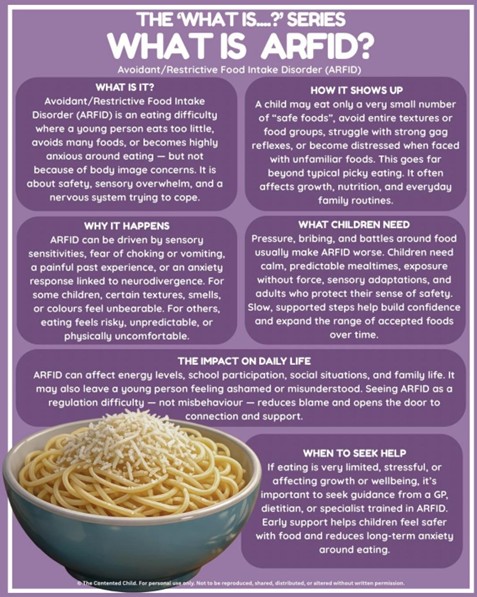
Seeking Support: We Are Here to Help
If your child’s eating is very limited, causing significant stress, or affecting their growth and wellbeing, it is important to seek professional guidance. Early support helps children feel safer with food and reduces long-term anxiety.
Support at the Academy:
You do not have to navigate this alone. If you have concerns about your child’s eating, please reach out to the College Teams at the academy for further support. We can work together to ensure your child feels safe and accommodated during the school day. Additionally, we can arrange School Nurse referrals to help you access the right medical and nutritional guidance.
External Specialist Support:
For specialist help, you can also make a self-referral directly to the Maudsley Centre for Child and Adolescent Eating Disorders. They offer dedicated support and assessment for young people struggling with eating disorders.
You can find more information and self-refer via their website here:
If you have any questions or would like to discuss your child’s needs in confidence, please do not hesitate to contact the school via the college team.
Leigh Academy Bexley is a Candidate School* for the International Baccalaureate Middle Years Programme (MYP) and Careers Related Programme (IBCP). This school is pursuing authorization as an IB World School. These are schools that share a common philosophy – a commitment to high quality, challenging, international education that Leigh Academy Bexley believes is important for our students.
*Only schools authorized by the IB Organization can offer any of its four academic programmes: the Primary Years Programme (PYP), the Middle Years Programme (MYP), the Diploma Programme, or the Career-related Programme (CP). Candidate status gives no guarantee that authorization will be granted. For further information about the IB and its programmes, visit www.ibo.org